Showing posts with label _Parker Sutton. Show all posts
Showing posts with label _Parker Sutton. Show all posts
Thursday, September 22, 2011

Tuesday, September 20, 2011
Book Joinery
In between routing attempts I experimented with other ways of joining books. The pictures and sketches below detail my attempt at a mortise and tenon joint.

I cut the tenon using a band saw, resulting in a clean cut.
 Publish Post
The mortise hole was done with an Olfa blade and was somewhat messier.

The pieces fit together reasonably well.

And make a T

Take Cover
The latest (coverless) iterations of book routing / joining have presented me with another design problem: what to do with the the leftover covers. I wanted to leverage the rigidity of the 8.5 x 11" front and back covers as well as the flexibility of the 2.5" binding. The first prototype looks something like this:


A spinal configuration with transverse covers bridging single row longitudinal covers. Laid out on the ground, it's strong enough to support at least 200 lbs (me), making it a potential base for a low-lying table. The flexible binding allows it to hinge around the center and stand on end, transforming it into a shelf.


Book Routing Vol II
Back to routing. And now, two weeks after the first try, a little success.


Adjustments since my last attempt:
1 The book routed today was dunked in a thin wash of water and elmer's glue, clamped between two pieces of scrap wood and left to dry for two days. While the perimeter of the book was dry when I unclamped it, the interior was evidently still wet and the book buckled (slightly). Regardless, the pages largely adhered and the resultant object was less flimsy than in previous efforts.
2 I took the cover off
3 I rotated the angle of the cut-direction 90 degrees so the end-mill would drag in the positive X-direction, one-way (not zig-zag), with the spine of the book aligned on the Y-axis
4 I routed to the end of the book in X direction but not the Y direction so that the area being cut would stay more or less level in the Z-plane (to clarify, the 8.5 inch sides remained intact and were trimmed with the band-saw)
The result: A pretty clean route (rough parallel). There's a visible grain that might become more pronounced with a smooth finish. The book less furry and more dense toward the margins of the page (where there's no text), suggesting that the ink may be impacting the final texture of the book.

Sketch ideas on how several books could be routed and joined to create a wavy form, even a chair or chaise. I'm also interested the possibility of shaping books before adhering them and creating joints between pre-curved pieces:

Tuesday, September 13, 2011
Book Routing
This past week saw three attempts at routing books.
The book: "Sweet's Catalog File."
Reasons why: The standard tome of building materials, they're ubiquitous, plentiful, and, at least nowadays, basically useless. Not only have they been digitized, but even in their prime they were updated and reprinted annually, meaning they found homes under drafting tables in a period of 12 months or less. I also like them because they're endemic to this building, architectural artifacts. The almanac of materials becomes obsolete, then becomes a material.

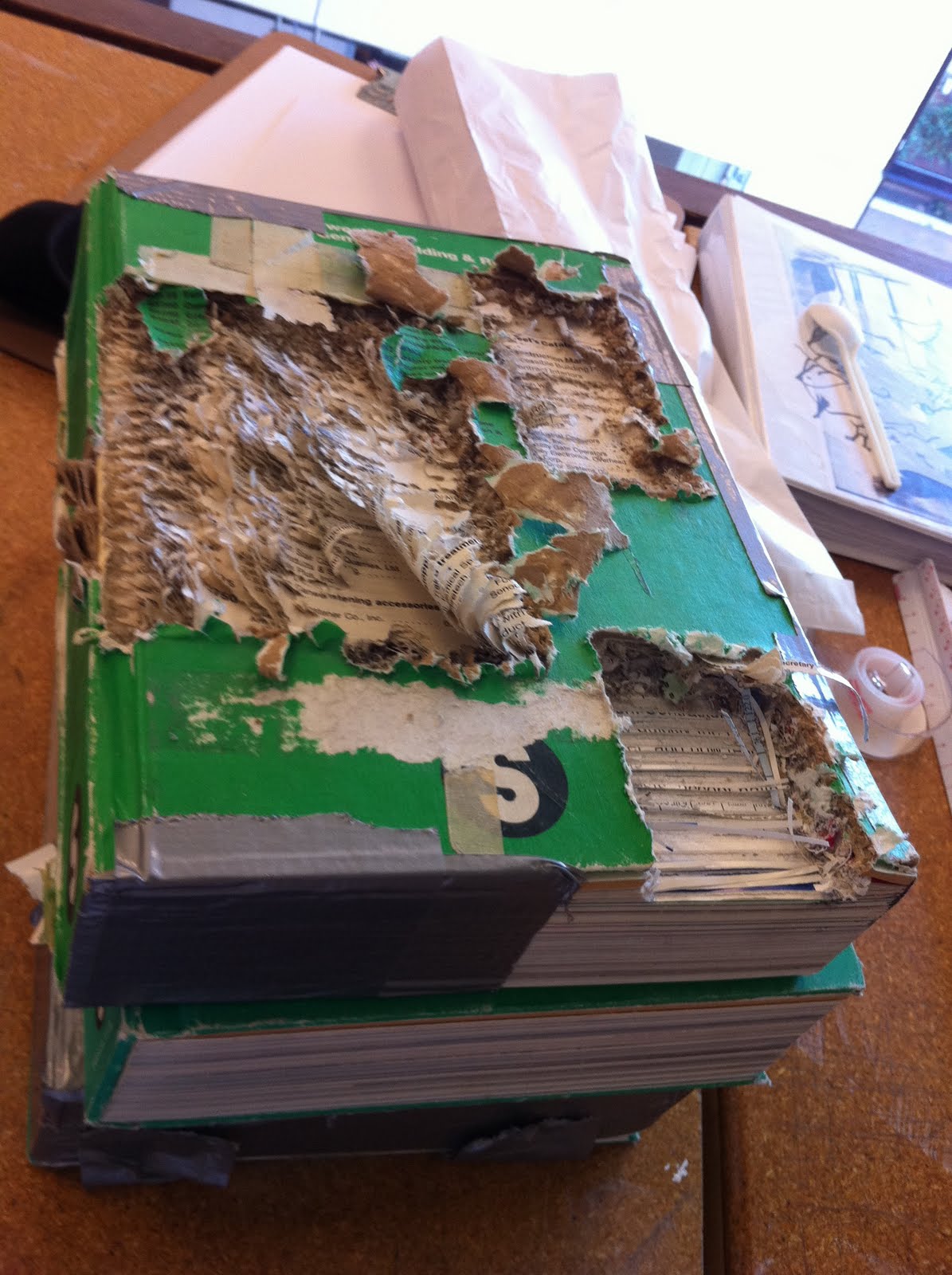
The first attempt (Sweet's 1995, Volume 2) uncovered several issues before it was aborted. For one, the covers of these books (old card) are messy under the router and cast off some nasty particulates. Once the bit reached the paper, things got more interesting. The square cut in the lower right (the opening of a joint, maybe) was reasonably clean and taught, as was the pocket (surface cut) above it. The concave cut close to the binding was less clean - after the first incision, the remainder of each page was sucked upward and led the bit to miss pieces of each page. After a few passes like this the router caught the binding, causing the book to spin and forcing us to stop. [Seen below are the 3D file and the mangled book]

More to come
Sunday, September 11, 2011
Flat Pack "Origami"

This project leaves a lot to the imagination (e.g., how is it origami?), but it flat packs, touches on the ever-topical emergency relief housing, and takes on a "molecule" form that glows by night:
http://www.archdaily.com/166151/origami-cave-emergency-shelter-lava/#more-166151
Tuesday, September 6, 2011
Material

Potential characteristics I'm looking for in a material:
1 Limited life-span
2 Perhaps obsolete (out-moded technology)
3 Abundant
4 Free
5 Locally available / universally available
6 Malleable structural properties (adaptable)
7 Routable
What I'm considering:
Newspaper: Life span of 1 day. All but obsolete in its physical form. Abundant. Free after disposal. Essentially wood pulp, can be reconstituted into rigid structure. Examples of this already exist: Newspaper wood! (See above) http://www.nextnature.net/2010/11/newspaper-wood/
Books (phone books): Similar to newspaper. Can be stitched, broken down and remolded, stacked, etc. Potential to be routed. Available in abundance at local recycling centers. A slightly ridiculous precedent: http://inhabitat.com/tu-delft-architecture-library-opens-with-desk-of-recycled-books/
Others: CDs / Tapes; wood palettes, packing foam, shipping containers.
Any ideas?
Sunday, September 4, 2011
OPEN
This is the last of my watercolor pop-ups, made using the scraps of previous efforts. I wanted to keep the abstract composition of the paper intact and so used a simple strip-pattern inside. I was also interested in how a piece could communicate to the reader before it was opened, hence the "OPEN" signage.
3.5" x 4". Watercolor on bristol paper with glue
Subscribe to:
Posts (Atom)